 Nick Freiling
Congress Is Too Small. We Should Make It Bigger.
How the arbitrary 435-member cap on the House of Representatives erodes truly local representation and intensifies the performative nature of American politics.
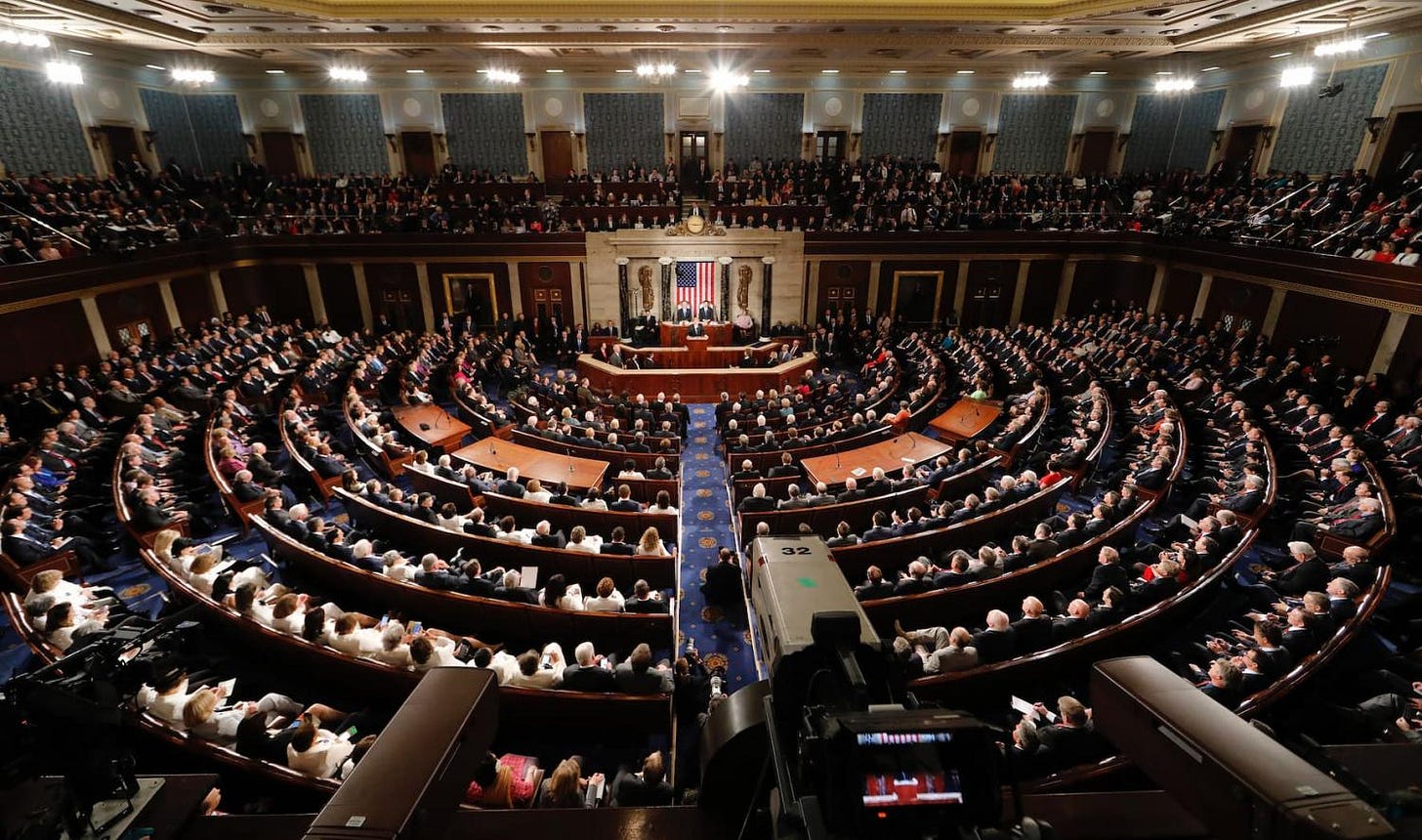
In 1929, Congress passed a procedural law that few Americans today could name. But the effects of that decision altered the very foundation of American democracy.
The Permanent Apportionment Act, which fixed the number of seats in the House of Representatives at 435, was sold as a neutral administrative measure. Proponents argued that too many Representatives would make running Congress difficult. In practice, this locked in a representational framework that increasingly empowers the smallest states regardless of how few people live in them.
The issue isn’t simply underrepresentation of large states like California. It’s that, thanks to the Constitution’s guarantee that each state gets at least one Representative, a capped House becomes less proportional with every census. The result is a form of democratic distortion that compounds over time. Today, the average Representative speaks for about 760,000 people – but in Wyoming, that figure is closer to 580,000.
This is not a glitch in the system. It’s the system working exactly as designed after 1929.
It’s often assumed this dynamic mostly harms Democratic strongholds like California and New York. But that’s not true. The second- and third-largest states – Texas and Florida – are overwhelmingly Republican. Because of the cap at 435 members, they, too, are being shortchanged. If the House had grown in proportion to the American population, Texas would likely have more than 50 Representatives today – not just 38. Proportional representation would make both parties stronger where their actual voters live instead of empowering whichever party can stitch together enough rural districts in overrepresented states.
And this imbalance doesn’t stop with Congress. It carries over into the Electoral College, where every state’s influence is tied to its number of House seats plus two Senators. Since each state gets two Senators regardless of size, and at least one Representative even if its population doesn’t justify it, the smallest states wield far more electoral weight per person than the largest ones. This helps explain how two of the last four presidents took office after losing the national popular vote.
(Notably, the last three Presidential elections would have still been won by the same candidates had the electoral points been allocated based on pre-1929 proportions, but each with larger electoral victories. In other words, a larger Congress would have delivered stronger electoral mandates to each winner.)
That isn’t just a quirk of federalism. It’s a symptom of a representational system that is frozen in time, increasingly incapable of adjusting to the reality of modern America. The population has more than tripled since 1929, but the House has not added a single seat. Districts are now so large that genuine retail politics is nearly impossible. It used to be that each Representative had roughly 200,000 constituents. Today, that number is roughly 760,000, and may hit 1 million before the end of the century if demographic trends continue.
With fewer Representatives, the incentives for people running for Congress shift toward celebrity, fundraising, and national partisanship. Representatives increasingly behave like social influencers instead of legislators because their job is no longer local. Voters don’t just think about who best represents their own local interests, but what type of person is needed to ensure Congress achieves a particular balance of power.
This helps illuminate something deeper about American political dysfunction. Gridlock isn’t just a result of polarization or bad faith – it’s baked into the structure. A coalition of lawmakers representing a minority of the population can reliably block policies that enjoy broad national support. And because this coalition is disproportionately made up of small-state representatives whose voters face little political competition, there’s little accountability.
The Founders anticipated a House that would expand with the population. For over a century, it did. Every decade brought new seats. The 1929 cap was the exception – imposed not for any grand constitutional principle, but to protect rural political power at a time of rapid urbanization. In hindsight, it was a defensive move that became a permanent one.
What would it look like to fix this? It wouldn’t require a constitutional amendment. Congress could simply pass a law increasing the size of the House – say, to 600 or 700 members. Doing so wouldn’t solve every problem, but it would restore some degree of proportionality, particularly for fast-growing states. It would also reorient the culture of the House toward local representation rather than media spectacle.
That such a move has never crossed the minds of most Americans speaks to how deeply we’ve internalized the current structure. Most Americans believe 435 is a constitutional number. It isn’t. It’s a relic – one that, for all its inertia, increasingly undermines the logic of representative government.
The real question isn’t whether big states are getting enough seats, but whether the very idea of proportional representation still matters in a country where the arithmetic of power no longer tracks the demographics of the people. Until that’s addressed, democratic legitimacy will continue to erode – not because of some crisis or scandal, but because the numbers simply don’t add up.