 Nick Freiling
Joe Rogan, Bullshit Sanitizer
It's hard to explain exactly what's wrong with the way Joe Rogan talks (and listens). But Harry Frankfurt did it in 1986.
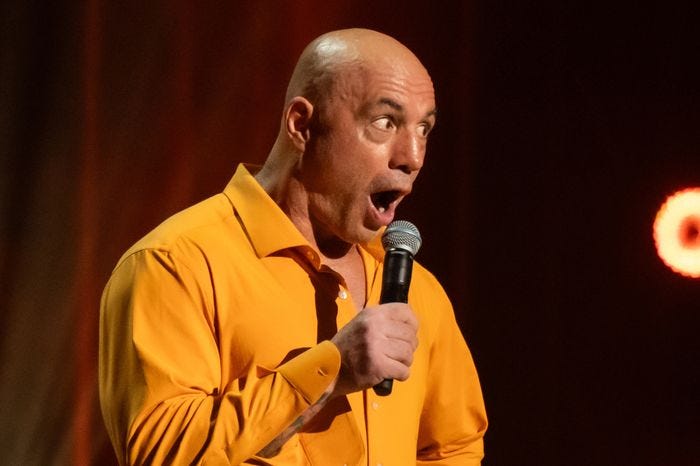
Over the past few months, several professional conspiracy theorists (yes, they literally conspiracy-theorize for a living) have appeared on major podcasts – Joe Rogan, Candace Owens, Theo Von, among others – alleging, with varying degrees of subtlety, that the Jews are secretly destroying the United States.
Some dance around the accusation, dressing it up with vague allusions to “globalists” or “elites” or “shadowy financiers.” Others dispense with the euphemisms altogether, opting for the sort of unvarnished paranoia that, until the past few years, was seen only on fringe internet forums, but now finds a regular home on mainstream platforms.
Now, I’m willing to entertain the idea that these people aren’t outright anti-Semitic, or that maybe, in their own minds, they’re honestly “just asking questions.” Maybe they think they’re uncovering something profound – some grand, hidden mechanism of power that only they are brave enough to expose.
But here’s the problem: by their own admission, they aren’t really “on to something.” They hedge. They smirk. They throw out a few eyebrow-raising “coincidences” and then quickly retreat behind the safety of plausible deniability. “I’m not saying anything definitive, I’m just pointing it out.” “It’s just interesting, isn’t it?”
And their hosts? Let’s focus on Joe Rogan, specifically. He nods along the whole time, for literal hours on end. Not just as some polite neutral moderator, but as someone who seems genuinely engaged.
But does he actually believe these people?
I don’t think he does. Nor do I think he’s intentionally trying to move the “Overton Window.” I think he’s just trying to have a good conversation and make more money. That’s the game. He likes weirdos, fringe thinkers, and people who seem like they know something the rest of us don’t because we, his audience, get bored with the same ol’.
In an especially tense episode just last week, Rogan’s guest – British historian and conservative Douglas Murray – took him to task for recently platforming conspiracy theorist Ian Carroll, whose amateur work calls into question some of the most widely-held historical consensuses of modern historians.
“It’s pretty hard to listen to somebody who says, ‘I don’t know what I’m talking about, but now I’m going to tell you what I think,’” Murray said. “If we all pretend Churchill was the bad guy of the 20th century, at some point, you’re going to lead people down a path where they think that’s the view, and that’s horseshit of the most profound kind.”
Rogan responded with uncharacteristic sheepishness. “I don’t think about it that way. I just think I’d like to talk to this person,” he says, as if giving a platform to Holocaust revisionism is the same as hosting a beekeeper. “I didn’t bring him on for that purpose. I brought him on because I want to find out, like, how does one get involved in the whole conspiracy theory business? Because his whole thing is just conspiracies.”
So it’s just about “conspiracies,” then – never mind the actual substance of what Carroll says. Rogan just wanted to platform conspiracy theory, and he simply used Carroll and his half-baked ideas to do that. Rogan might as well have interviewed a fictional character – Dale Gribble ranting about black helicopters, or Abed Nadir spinning a meta-narrative – and let them set the agenda. At least then we’d know it was just for fun, like Rogan seems to say.
To some extent, I get it (although it seems a bit insulting to take his guests with such a grain of salt). Controversy sells. Rogan isn’t exactly known for his intellectual rigor, so he can get away with it – with not taking full responsibility for the implications of his platforming.
But I think that makes the whole game even worse. Because while Rogan isn’t known for his intellectual rigor, he’s not a stupid guy. He’s smarter, I think, than he lets on. So as it stands, he’s just a guy with an expensive microphone and a massive platform who nods along because it’s easier, because it’s lucrative, because he doesn’t want to push back too hard and risk alienating the audience that made him rich or becoming too “mainstream.”
In so many ways, it’s nothing more than cowardice disguised as curiosity. And it’s borderline pathetic.
“You have to admit…”
I’ve brought this up to people before. Lots of people—regular Rogan and Rogan-adjacent listeners—respond with some level of sheepishness. Usually they even look down, or away. “Yeah,” they say, shrugging their shoulders. “That guest was kind of crazy. But you have to admit, those are some pretty wild coincidences.”
Oh, really? Pretty wild? So what could it mean, exactly? Do you think it’s possible that, if not for the Jews, we’d all be living in some utopia? That if only they weren’t around, lots of society’s problems simply wouldn’t exist?
They deny that, too. “I mean, I have nothing against Jews,” they say. “Seriously. I have Jewish friends.”
Hmm. Would you listen to these episodes alongside them? Have you asked them what they think about all this? Or would their understandable offense simply get in the way of the fun?
But the fact is, it’s hard to explain what’s wrong with how Joe Rogan talks, even if so many of us feel it in our bones. And it’s why so many people continue to listen who, ultimately, never seriously believe almost anything said on the podcast. I think most listeners know something is weird about it all.
On Bullshit
In his iconic 1986 essay On Bullshit, Princeton philosopher Harry Frankfurt set out to define a word that everyone uses but few analyze. He wasn’t interested in everyday lying or rhetorical fluff. His goal was more elemental: to explain what bullshit is, how it operates, and why it’s corrosive to truth.
And while Frankfurt couldn’t have known it at the time, his essay doubles as a field guide to understanding Joe Rogan, Ian Carroll, and the online manosphere’s favorite pastime: saying things that sound serious without ever meaning to be held accountable for them.
Here’s the core of Frankfurt’s argument.
The OED defines a bull session as “an informal conversation or discussion, esp. of a group of males.” … What is distinctive about the sort of informal discussion among males that constitutes a bull session is, it seems to me, something like this: while the discussion may be intense and significant, it is in a certain respect not “for real.”
This is Frankfurt’s first critical point: bullshit is male-coded performance. It thrives in the dynamic where men, usually too emotionally-guarded for this kind of vulnerability, find a comfortable “safe-space.” They won’t voice their private, outlandish opinions around their family or coworkers, of course, and they’ll try to blame “political correctness” for that. But they’ll open up on the biggest podcasts in the world when they’re insulated by the unspoken agreement that nothing said is binding. In these spaces, honesty is less important than vibe. Conviction is less important than swagger.
This is why Rogan’s show doesn’t feel like propaganda—because on the surface, it’s just a bunch of guys “shooting the shit.” The stakes feel low. The tone feels unserious. But it’s a very particular kind of unseriousness: the kind where serious topics are played with, not examined. The ideas don’t come with disclaimers—they come with winks.
You can see this dynamic in who participates. Besides Candace Owens, whose audience is also majority-male, how many women operate in this space? How many females go on Rogan’s show to spin casual theories about Jews, culture, or shadowy elites? Almost none. Because this genre of bullshit, as Frankfurt makes clear, is gendered. It’s not just a behavior; it’s a ritual of male bonding. And Rogan’s audience reflects that – more than 80% male, according to most surveys.
Frankfurt continues:
The participants try out various thoughts and attitudes in order to see how it feels to hear themselves saying such things… without it being assumed that they are committed to what they say.
This is critical point #2: plausible deniability is the currency of the bullshit economy. Guests say things like “I’m not an expert, but…” or “I’m just pointing something out…” and Rogan nods along, not endorsing, not condemning—just vibing. Everyone gets to participate in the game of speculative taboo-breaking without owning any consequences.
That’s the core appeal. Not clarity. Not truth. Not even genuine inquiry. The appeal is in the performance of daring to “go there.” And if someone calls it out? You were just joking. Or just curious. Or just listening. The fallback is always ready.
Each of the contributors to a bull session relies, in other words, upon a general recognition that what he expresses or says is not to be understood as being what he means wholeheartedly or believes unequivocally to be true. The purpose of the conversation is not to communicate beliefs. Accordingly, the usual assumptions about the connection between what people say and what they believe are suspended.
That last line could be Rogan’s tagline.
It’s why shows like his can host someone casually implying Jewish conspiracies are behind American decline, only to turn around and say: “Hey, I’m not saying I agree – I just like talking to interesting people.” The game is to say what others won’t, blame that reticence on “political correctness” run amok, and then insist that it all means nothing, anyways.
Frankfurt wraps it up:
These statements are unconstrained by a concern with truth… Bull sessions are, indeed, quite probably a sanitized version of bullshit sessions.
And that’s where the real danger lies. Because bullshit isn’t the same as lying. It’s more corrosive. A liar at least cares about what’s true enough to try to conceal it. The bullshitter doesn’t care whether something is true or false. He’s focused only on the sort of reaction he gets.
And when the same bullshit gets repeated enough – on a massive platform like Rogan’s – it becomes background noise. It starts shaping belief through osmosis. It bleeds into the mainstream, where it stops being performance and starts becoming policy.
So yes, On Bullshit is about language. But it’s also about cowardice. About what happens when you trade honesty for vibes. About how unserious people with massive audiences accidentally launder dangerous ideas into public discourse by hiding behind the thinnest veneer of “just wondering.”
Frankfurt could’ve called it On the Manosphere and published it tomorrow. Nothing would need to change.
How to Respond?
That’s all good and well. But isn’t this kind of thing just perennial? Will it ever really go away? Is this just a “Boys will be boys” sort-of thing, mostly-harmless and, at the end of the day, a built-in feature of human society?
Maybe so. But so is being stupid. We don’t have to give ourselves over to the paradigm. We can try to be serious and thoughtful with our words, even when it’s not fun. We can resist the temptation to turn every conversation into an audition for edge-lord status, or a social experiment in how much we can get away with saying before someone calls us out. We can stop treating serious matters – antisemitism, historical revisionism, conspiratorial politics – as party tricks for podcast banter, coming in just between the ads for “cooking-for-one” meal-kits and overpriced nicotine pouches.
We can also start holding people like Rogan accountable – not with cancel campaigns or purity tests, but with the thing they fears most: boredom. We can get bored of the bullshit. We can stop pretending it’s funny to watch someone sit in a leather chair and entertain genocidal theories with a shrug and a vape. We can demand better conversations, with people who actually care about getting things right, even if they’re less entertaining.
Because at some point, the line between bull session and bullshit breaks down. When the same “just asking questions” routine gets repeated enough, it stops being hypothetical. It starts shaping how people think. What begins as unserious talk becomes, slowly and insidiously, a kind of ambient worldview – one where nothing can be known with any degree of certainty, everything “mainstream” is suspect, and the worst ideas are never really removed from the table.
And in this fog, bad actors thrive. Not lovable cranks or harmless eccentrics, but angry people with hidden (and, sometimes, not-so-hidden) agendas. People who know how to ride the wave of “I’m just saying” into something far darker.
Call me a party-pooper. Self-righteous, even. But injecting continuous strems of bullshit int our ears has consequences. The longer we let cowardice wear the mask of curiosity, the harder it’ll be to tell the difference between the two. At some point, someone has to call it what it is – before the whole thing goes mainstream again.