 Nick Freiling
Jordan Peterson and the Mysterious Case of the Very-Involved Dads
Dads have never been more involved in their kids' lives. So why do so many young men look to online influencers for father figures?
Young men are starved for father figures.
That’s what they say, at least, to explain the continued and meteoric rise of the “father figure” influencer – middle-aged men like David Goggins, Patrick Bet-David, Gary Vaynerchuk and, most notably, Jordan Peterson. Indeed, in one of the earliest (albeit brief) analyses of the Jordan Peterson phenomenon, National Review profiled the Canadian “self-help guru” and his meteoric rise on YouTube in 2017, saying:
Peterson connects his message to something eternal, offering mytho-intellectual fatherly advice that men, especially Millennial men, are starved for in an age of perpetual and trivial digital distraction.
Of course, Peterson has only become more popular since then. As of today, he has 5.6 million followers on X and 8.6 million on Instagram. His 2018 self-help book 12 Rules for Life has sold, according to his website, more than 7 million copies. More than 850,000 people have purchased tickets to any number of his popular in-person lectures. His YouTube channel boasts more than 8 million subscribers, where he’s posted more than 1,000 long-form videos covering an increasingly diverse set of topics – videos with titles like Talking to Muslims About Christ, The Fight Against Worldwide Child Slavery & the Sex Trade, Introduction to the Idea of God, and The Origin of COVID-19.
But while his topics of discussion have diversified, his core message remains the same. Per his podcast’s official description, Peterson offers “a new perspective and a modern understanding of your creativity, competence, and personality” that caters predominantly to men – a demographic Peterson says comprises more than 90% of his audience.
A “new perspective” – that’s the key. Peterson represents, as cultural critic Anthony Bradley described all the way back in 2018, “the father and pastor that thousands of Millennial and GenZ men have needed for nearly thirty years.”
Jordan Peterson, savior of young men. It’s a nice story – endearing, even.
But is it true?
Fathers Today
Over the past 50 years, parenting behaviors in the West have changed dramatically. In fact, it’s hard even to identify some sort of baseline when it comes to how much time, and what kind of time, parents spend with their children. For as long as any standardized “parenting metrics” have existed (just a few decades), the way parents spend their time in regards to their children has been in flux.
But one thing is for certain: Parents today – both mothers and fathers, and especially the university-educated – spend vastly more time than ever before with their children.
In a landmark 2016 study by sociologists Dotti Sani and Treas, parents across the United States and Europe were demonstrated to have more than tripled, on average, the time they spend each day with their children. Our World in Data visualizes their findings below:
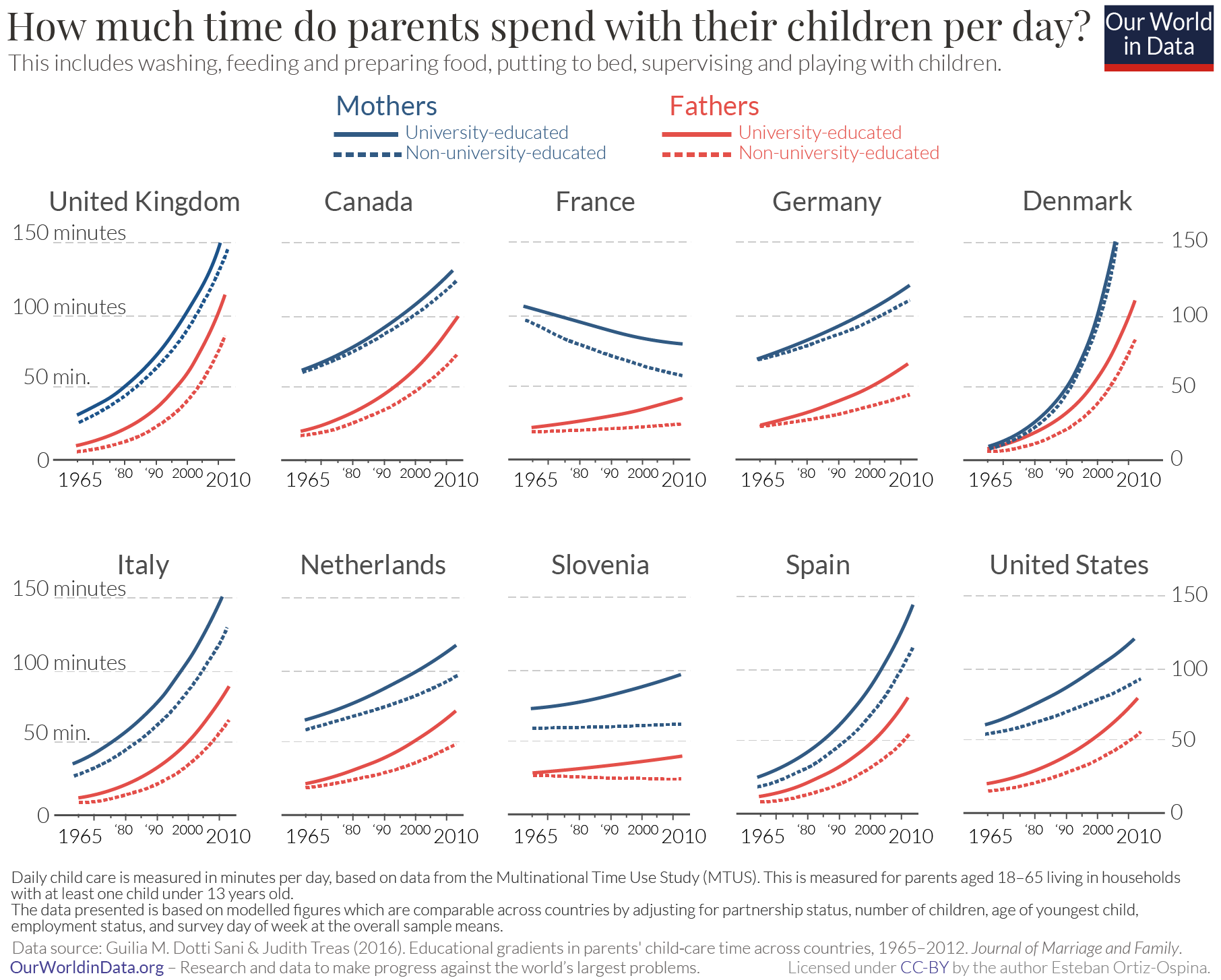
With the exception of France, every country surveyed showed a significant – massive, even – increase in the time parents spend with their children (in this study, children means those under 13 years old). And this study was conducted before COVID-19, which saw millions of parents in these countries move more-or-less permanently to a work-from-home arrangement, cutting out the time spent commuting on either end of the workday, and (in the United States, at least) more-than doubling the number of children being schooled at home by their parents.
Pew Research has researched the role and behavior of fathers, specifically. In 2013, they reported that between 1965 and 2012, fathers almost tripled the time they spend with their children – from 2.5 to 7.3 hours per week. That study is, of course, now 14 years old, but more recent research confirms that this trend has only accelerated.
Of course, this hasn’t all happened in a vacuum. Since 1965, the number of American children raised in single-parent households, born out-of-wedlock, and raised predominantly by a step-parent have all increased dramatically. Simply spending more time with their kids isn’t the only thing that’s changed for the average parent. But the data that Pew (and other researchers) use to measure time-spent-with-kids is all-inclusive – even divorced dads, for example, are still spending more time with their kids than did such dads in the past.
The simple fact is, dads are more involved in their children’s lives today than probably at any time in the history of the West. There’s hardly a question about it.
Replacing Dad?
Is it true, then, that the “Jordan Peterson phenomenon” is about young men’s need for more paternal validation than they got growing up? For more fatherly encouragement and instruction? For someone older and wiser to show them the way?
Is the 19 year-old teenager who binges Peterson videos for hours on end really trying to “re-father” himself?
We can’t know, of course, what exactly goes on in the mind of Peterson’s fans, and there are ostensibly many reasons one might like the man. It’s probably true that many of his followers felt aimless before stumbling upon one of his videos (aimlessness and angst, and even clinical mental illness, are hallmarks of modern adolescence). Lots of teenagers, both males and females, are depressed and many of them don’t like their parents.
But did these teens’ parents fail them? Is that what predicts interest in people like Peterson? More specifically, did all of these dads, spending more time than ever with their sons, somehow drop the ball?
It’s not an easy question to answer. But new research published in the Journal of Neuroscience sheds some important light on just what goes through older adolescents’ minds when mom and dad talk. Psychiatrists Abrams, Mistry, Baker, Padmanabhan, and Menon write:
Using functional brain imaging of human voice processing in children and adolescents (ages 7-16), we demonstrate distinct neural signatures for mother’s voice and nonfamilial voices across child and adolescent development in reward and social valuation systems, instantiated in nucleus accumbens and ventromedial prefrontal cortex. While younger children showed greater activity in these brain systems for mother’s voice compared with nonfamilial voices, older adolescents showed the opposite effect with increased activity for nonfamilial compared with mother’s voice. Findings uncover a critical role for reward and social valuative brain systems in the pronounced changes in adolescents’ orientation toward nonfamilial social targets.
In other words, older adolescents are less likely to listen to their parents than to strangers. Brain activity associated with the “reward and social valuation systems” show increased activity for non-familial voices in positive correlation with a child’s age (the older the child, the less mom’s voice resonates).
I suspect that most parents of teenagers didn’t need a study to tell them this. And most adults, if they’re honest, can probably point back to a time during their adolescence or early adulthood where they ignored mom and dad’s rules to experiment with their own way of life, or to listen to some other mentor (a coach, or an older friend) instead. “Coming of age” films and books are aplenty, after all, and the “rebellious phase” has become a virtual rite-of-passage for American teens.
So perhaps what’s really going on here is nothing new. When Peterson says “Stand up straight with your shoulders back” (the title of Chapter 1 in his book), his audience listens because, well, he’s a stranger. Mom and dad may feel like they’re talking to a wall when they suggest as much to their teenage son day after day, but Peterson gets it done. And maybe it just doesn’t matter how much more time dad spends with their kids – yes, teens are with their parents more than ever before, but they just don’t listen.
In this way, Peterson (and those like him) are, perhaps, more the fortunate recipients of a perfect storm of time-and-place than some sort of “mytho-intellectual” teen-whisperers. The internet simply made it possible for someone to be everyone’s “online dad” by sharing nothing more than very basic advice – literally, “clean your room” (the kind of thing most teenage boys have heard from mom and dad a hundred times before).
The Phantom Father Archetype
If that’s true – if someone like Jordan Peterson was simply bound to happen – then the whole thing is probably harmless, or even good. After all, standing up straight and cleaning your room are good things for young people to do, and thousands of testimonials both online and at Peterson’s in-person lectures attest to the idea that his impact on his audience is very real and very positive. His politics aside (and he’s become markedly more political in recent years), a 19 year-old male could do a lot worse in terms of finding someone online to follow obsessively.
But I think there’s a dark side to rhetoric like Peterson’s. It happens when young men become genuinely convinced that they never heard any of this stuff before – that dad failed to help them become a man and so they need to listen more closely to people like Peterson (and Goggins, and Vaynerchuck, and even Andrew Tate), even at the expense of listening to real-life mentors.
Why do young men feel they can so publicly embrace Peterson and ignore dad? I think much of it has to do with a shared cultural vision of an “archetypical father” – a strong, manly, steady, ambitious, caring, and hard-working male authority – that simply is not easy to see in dear ol’ dad. It’s a picture of strength, vitality, and stability that many Peterson fans (and, for that matter, Peterson himself) allege is not prized today as much as it was in the past. “There is a backlash against masculinity,” Peterson said in a popular 2018 BBC interview. “The masculine spirit is being increasingly demeaned.”
Maybe he’s right. To be sure about that would require a lot of study. Many of his fans may scoff at the suggestion that (their definition of) masculinity is not under existential threat by forces more-or-less beyond their immediate control. But separating a secular “de-masculinization” trend owing, perhaps, to changed diets and more sedentary working conditions from some active campaign against masculinity isn’t as easy as those scoffers are likely to insinuate.
Nevertheless, a picture of masculinity has emerged in recent decades that has a strong hold on young people (especially males) today – an aspirational “father archetype” that has young men striving to gain and wield a particular sort of power over themselves, others, and the circumstances around them. The vision is, I think, of a man much bigger and more powerful than the more passive “cog-in-the-machine” they feel “society” raised them to become.
But where does this picture come from? It’s easy to find examples in modern literature and film – think Mufasa (Lion King), Captain Von Trapp, Bryan Mills (Liam Neeson in Taken), Cooper from Interstellar (played by Matthew McConaughey). Even Donald Trump fits the bill in many of his fans’ minds. Tony Stark is arguably the most powerful man in the world and yet sacrifices himself, on his own volition, for the sake of his daughter. The examples are endless.
But what about older, more traditional examples of such a figure? From antiquity, or even early-modern literature? Well, those are harder to find insofar as we limit ourselves to the narrow mythical imagination commonly available to American boys and men today.
Consider the Scriptures. Proverbs, much of it narrated by a father figure sharing wisdom with his “children,” arguably demonstrates such a figure – eminently wise and perfectly confident. Joseph the adoptive father of Jesus, too, is depicted (especially in Roman Catholic lore) as a “protector” – hard-working, self-sacrificial, a “strong-silent” type. And perhaps Job, who was “blameless and upright,” father to seven sons and three daughters, and the proud owner of seven thousand sheep, three thousand camels, five hundred yoke of oxen, and five hundred she-asses, and very many servants (the book calls him, on account of his progeny and his wealth, “the greatest of all the people of the east”).
But aside from these examples, a Biblical “father archetype” is elsewhere hard to find. Even Yahweh himself exhibits considerable emotion in the Old Testament, changing his mind and becoming enraged, even “regretting” what He did and “relenting” in the face of Abraham’s and Moses’ insistence. “Father Abraham” was prosperous and his obedience to God was, per Hebrews, ultimately credited to him as righteousness, but he also doubted God’s promises and fathered a complex and broken family situation that set off generations of intense conflict. King Saul was paralyzed by fear, sought the help of a medium, was ultimately defeated by his enemies, and then killed himself. King David – wracked with doubt and overwhelming fear – was a murderer, womanizer, and even chose, near the end of his life, to flee his throne and his city rather than face his own son. Zechariah didn’t believe his wife and was, embarrassingly (especially for a priest), struck mute by God for several months. At least two of Jesus’ disciples left their own father empty-handed to become Jesus’ disciple, and none of the disciples were known to have started or raised families of their own – at the very least, no mention is made of this aspect of their lives, if it existed. Jesus, of course, was a 30-something year-old unmarried man with close female friends at whose home he was known to stay. And the Apostle Paul, of course, suggests that it’s better for a man not marry and not to have children, but rather to live chastely and quietly, submitting to authorities and staying out of political squabbles.
None of these examples paint a compelling picture of the sort-of figure that many young men today have in mind when they imagine a strong and maximally-masculine father. And, for that matter, nor does Peterson himself. He’s rail-thin, sickly-looking, and highly-emotional. His voice is weak and shaky. His appearance is that of a stereotypical flimsy-wristed academic, even to the point of caricature. He’s recently struggled with drug addiction. He wears flamboyant ties and bright neon colors. By his own admission, his wife’s cancer diagnosis in 2019 sent him into a years-long nervous breakdown.
(And, for what it’s worth, his own room – seen in the background of his older videos – was usually quite messy. He even admitted to getting his start as an “influencer” by lurking around on the internet in the middle of the night, answering stranger’s questions on Quora.)
So what makes Peterson and his ilk so special to so many young people?
Dad, a Peterson Fan
A few years ago, I attended a Jordan Peterson lecture in-person in downtown Jacksonville, Florida. I wouldn’t have purchased tickets to this event, but a friend had one for me.
We arrived almost an hour early, and I had the chance to observe people filing into their seats. The event was almost sold-out, which means there were almost 1,900 people in attendance.
The audience appeared to be more than 90% male. And interestingly, a number of them were in attendance with men who appeared to be their own fathers. Even the friend who invited me had brought along one of his father-figures – an uncle who, I later learned, paid for our tickets (and then later our dinner) that evening. My own father, too, would undoubtedly have attended had he been in town, and he probably would have paid for my ticket.
Call me crazy, but I’m not willing to bet that these fathers were persuaded by their sons to attend Peterson’s lecture in order to learn all the things they failed to do, as fathers – all the truths they forgot to communicate to their sons. In fact, I think the opposite is true. I think these fathers are as much fans of Peterson as are their sons, and it’s because he more eloquently and persuasively communicates the same values they did, in fact, try to pass on.
So is Peterson just speaking to the choir? I think that’s probably more true than not, and, for that matter, true of most “influencers” (in other words, they really don’t influence much of anything). I’m unconvinced these types have really “moved the needle” much. But if we give even the smallest benefit of the doubt to the many voices (mostly online) who cite Peterson as a true, life-giving inspiration, then there’s probably something else going on, but it doesn’t correlate with some dearth of fatherly influence in the average young man’s life.
Here’s what I think: Jordan Peterson resonates now, more so than someone like him might have resonated in the past, because most young men do understand what masculine responsibility should look like. They learned it from their many male teachers and sports coaches and from their very-involved dads. They saw it on TV and on the big screen, too – many (even if not all) Hollywood father figures fit this mold. In fact, I think the idea of a strong, masculine father is almost innate and perhaps even more well-defined (and even exaggerated) today than in the past.
So I think what young men love about Peterson is, simply, that he can speak it. He knows what’s inside, and he brings it to the surface with long, rambling, and admittedly insightful monologues. Remember, he himself doesn’t obviously demonstrate many of the virtues he espouses, nor is he a picture of male strength and vitality (or even of health). But he’s an eloquent defender, with the microphone and the pen, of the things most men of all ages believe, for better or worse, are right and good. Somehow, young men today have a positive archetypical vision of the ideal father, strong and steady, that persists even despite all the alleged attacks on it from a “feminized” culture (though if you watch any popular Hollywood movie, the archetype seems to be very much in vogue – more often platformed, I think, than demonized).
And of course, Peterson frames all this in terms of a conflict – a heroic battle with oneself, with one’s demons, and with a broader culture that (allegedly) has it out for men who strive to be principled, “masculine,” and self-reliant. That’s exciting stuff!
Now, I’m not convinced our broader culture is really so opposed to the values Peterson promotes, nor do I think a reactionary stance is how he got popular initially. If I ever liked Peterson, it was when he pointed men to the enemy within, and not outward to (primarily political) figures like Kamala Harris, Greta Thunberg, or, hilariously, Pope Francis (that curmudgeonly embodiment of nihilism and self-centeredness, am I right?). Nevertheless, his framing is effective – it always raises the stakes to have a big, bad enemy lurking around the corner.
Anyways, I think most fathers can and do demonstrate masculine virtues sufficiently to their sons, and have done so without much variation for a very long time. It’s not all on dads, anyways. My own sons are incredibly forgiving of my flaws, and always seem to see the best in me because it’s what they desperately want to see. Being their “superman” isn’t hard, and I hope and suspect they’ll pick up enough of my better qualities before they inevitably age out of my fan-club.
But as they grow older (my oldest will soon be a “pre-teen”), I assume it will be harder for me to live up to their expectations. I imagine the more they understand who I am, the less impressed they’ll be with me (I’m nothing special, after all). Even if I practice what I preach well enough, the stresses of day-to-day and minute-to-minute parenting my five children are going to put me in a tough light – quite unlike the dozens of spotlights at the Peterson lecture that had him literally glowing on the stage.
I think the more time I spend with my kids, the harder it will be for them to look past my weaknesses. After all, as the research I cited above demonstrates, eventually they just quit listening. Perhaps spending more time with our teenage sons isn’t necessarily good for their psyches.
But no matter what, explaining and defending your values in front of a sometimes-hostile world will always paint a more compelling – even downright heroic – picture than whatever figure dear ol’ dad projects while he stands in line at Home Depot on a Saturday morning, flip-flops on and a Dunkin’ Donuts coffee in-hand. Real, day-to-day fathers simply don’t stand a chance against the freedom and mental acuity that empty-nester Jordan Peterson enjoys as he picks fights and demonstrates his impressive cultural vocabulary (one honed, of course, over decades of study at an Ivy League university while being financially supported by his wife).
I digress. The bottom line is this: our expectations of parents (fathers, especially) are distorted by very-modern and hyped-up archetypes that no real-life dad, no matter how present or competent, could fully embody. Figures like Peterson succeed not because they replace chronically-absent fathers but because they occupy an entirely different space – one made possible more by technology than by some cultural sickness (I tend to think the technology itself is the cultural sickness, but that’s for another essay). Peterson father-types are cultural symbols, unburdened by the messy, imperfect realities of day-to-day parenting. At 62, Peterson is more appropriately analogized to a detached grandfather dropping in with advice on Sunday afternoon (and bowing out before bedtime chaos begins) than to a struggling, 32 year-old dad trying to feed six mouths on a $50,000-plus-commission salary. Peterson may articulate truths that fathers try to convey, but he does not replace them anymore than grandpa living four states away can replace dad.
Oh, and it’s simply not true that modern men are uniquely un-fathered. There is no evidence of this. For the many young men, and many of Peterson’s fans, dad was (and remains) more present and engaged than ever. We just didn’t listen to him, and I think it would behoove us as men and individuals, and even as a society, to more readily admit that.